


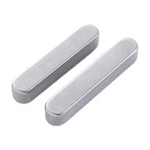
Pins
What is Pins
Dowel pins are sometimes referred to as straight pins or lock pins. In a manufacturing setting, dowel pins are solid, headless, cylindrical metal rods that have been machined to specific tolerances. These pins are typically used to align, locate, or join component to absorb lateral stress. However, they can also be used as a pivot, shaft, or hinge. Metal dowel pins are popular for manufacturing, metalworking, and precision engineering applications in many industries, such as: automotive, aerospace, tool and die, prototyping, electrical components, and military.
Advantages of Pins
Accurate alignment
Parallel dowel pins are designed to fit tightly into corresponding holes, ensuring accurate alignment of parts and components. This helps reduce wear and tear and prolongs the lifespan of the equipment.
Increased strength
Parallel dowel pins can transmit more load and forces than other types of dowel pins, thanks to their uniform diameter and increased length-to-diameter ratio. This makes them ideal for applications that require high strength and rigidity.
Lower assembly time
Due to their precise fit and ease of use, parallel dowel pins can greatly reduce assembly time and effort. They also eliminate the need for additional hardware, such as screws or bolts.
Reusability
Because parallel dowel pins are made of high-quality materials, they can be reused multiple times without losing their strength or performance.
Variety of Sizes and Materials
Variety of Sizes and Materials
Consistent Alignment
Parallel dowel pins offer consistent alignment and positioning, reducing the risk of errors and improving overall product quality.
Versatile
Parallel dowel pins can be used in a wide variety of applications, including furniture construction, cabinetry, automotive manufacturing, and more. This versatility makes them a valuable addition to any workshop or manufacturing facility.



Why Choose us
Reputation
A company with a positive reputation is more likely to attract customers. Reputation is built through consistent quality service or products, good customer relations, and reliability.
01
Customer service
The company offers excellent customer service and support, making it easy for customers to resolve any issues they may have with the product.
02
Quality assurance
We prioritize delivering high-quality services, and our output is subjected to quality checks to ensure that our clients receive the best possible services.
03
Competitive pricing
We offer competitive pricing on all our products without compromising on quality.
04
Innovative and unique products
We are always creating innovative and unique products to keep our customers interested and engaged.
05
Material of Pins
Alloy Steel is the strongest of all steel types. It has high tensile strength and offers excellent resistance to wear, fatigue and galling.
Case Hardened Carbon Steel is less brittle than carbon steel and will not fracture under high stress.
Stainless Steel is a strong, corrosion-resistant alloy with excellent resistance to heat. It is used in high-stress, outdoor and corrosive applications.
Nylon is a lightweight, nonconductive material that is resistant to impact, wear and abrasion. It is ideal for electrical applications or where corrosion is a concern.
Wooden dowel pins are ideal for furniture building and cabinetry for structural reinforcement. Offered in both fluted and spiral, they are effective for simple repairs and fast joinery.
Different Types of Dowel Pins

Precision
Precision dowel pins are usually made of steel or stainless steel and range in diameter from ⅛' to around 1.25' with a standard diameter tolerance of +.0000/-.0002'. Their length can vary based on the manufacturer and they can be easily machined for custom modifications. Precision pins and standard dowel pins are the most common types of pins for pivots, hinges, shafts and jigs.

Grooved
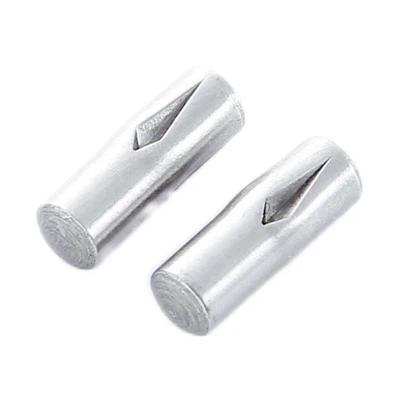
Groove dowel pins are less commonly used, and are only offered in a few sizes. They have a small groove in them which tightens when located creating tension and holding the pin in place. The remainder of the pin can be used for hinges or pivots.

Oversized
Oversized dowel pins are simply oversized dowel pins offered in nominal sizes with a diameter tolerance of +.0009 ’ /+.0012 ’. These pins are most commonly used as replacement parts.
Standard
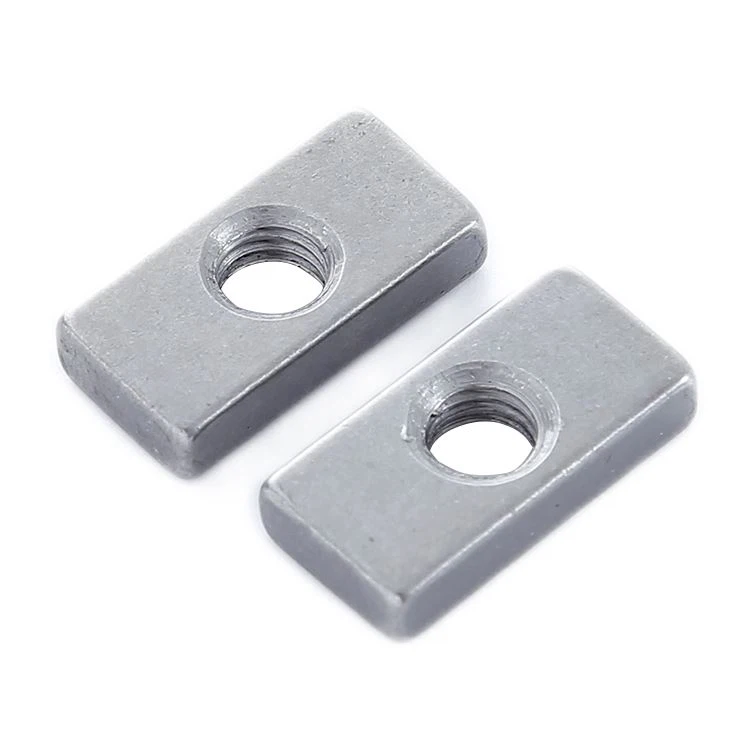
Standard pins can be made of steel, stainless steel, aluminum or brass and range in diameter from 1/64 ’ to 1.25 ’ with a standard diameter tolerance of +.0001’ /-.0003 ’ . Their length can vary based on the manufacturer and they can be purchased with a number of variations to them including: chamfered, flat and rounded. Precision pins and standard dowel pins are the most common types of pins for pivots, hinges, shafts and jigs.

Pull-out
Pull out dowel pins have one end that is chamfered and the other end is tapped. This provides assistance which installed the chamfered end into a fixture, and allows for the pin to be removed from the tapped side.
5 Things to Consider When Choosing Dowel Pins
Material - You'll need to consider the material when choosing dowel pins. Wooden dowel pins are typically used in furniture and woodworking applications, whereas metal dowel pins are typically used in machines and equipment. You can find metal dowel pins made of stainless steel, carbon steel and hardened alloy.
Size - Dowel pins come in a wide range of different sizes. For a set of dowel pins to join two or more objects, they must feature the correct size. If a dowel pin is too long, you won't be able to fully insert it into the objects. If it's too short, on the other hand, the dowel pin may fail to hold the objects together. Evaluate the objects with which you intend to use them, and choose dowel pins in the correct size.
Thread type - You should also consider the thread type when choosing dowel pins. Dowel pins can have fine or coarse threading. Coarse threading means a dowel pin has fewer notches or pitches. In comparison, fine threading means a dowel pin has more notches or pitches. Which thread type should you choose? It really depends on the application. If you're using them to join objects with fine threading, you should choose dowel pins with fine threading. For objects with coarse threading, conversely, you should choose dowel pins with coarse threading.
Thread size - In addition to the thread type, pay attention to the size of a dowel pin's threading. Dowel pins are typically designed with threading in a specific size. Some of them have 1/16-inch threading. Others have 3/32-inch threading. As mentioned above, the threading of a dowel pin should match that of the objects with which you intend to use it.
Customization - Finally, you may want to consider customization when choosing dowel pins. With customization, you won't be restricted to any specific size. Rather, you can order a set of custom-sized dowel pins to achieve a perfect fit. Not all applications require the use of custom-sized dowel pins. If the objects feature standard and uniform threading, you might be able to use a set of standard dowel pins. For other applications, though, custom-sized dowel pins may be required.
Top 5 Basic Elements Of Dowel Pins
Accepted materials
More often than not, dowel pins are made of a steel alloy that incorporates minor percentages of sulfur and phosphorus, 0.04% and 0.05% to be more precise. However, because the pins are used in several industries – including water treatment, pump manufacturing, steel fabrication and railroad construction – they are also available in other materials, such as bras, 18-8 and 316 stainless steel, aluminum and titanium.
Design
Irrespective of the metal alloy it incorporates, the pins need to undergo a hardening process known as austenitization. This procedure is commonly used on iron-based metals and implies subjecting them to an excessive temperature that allows the alteration of the crystalline structure to austentite (gamma-iron).
Hardness factor
The role of the austenitization process is to achieve a certain level hardness for the interior and another for the exterior of the dowel pin. To put it simply, according to ASME's standards a dowel pin has been manufactured correctly if it has a hardness of at least 60 on the case and a level of solidity between 47 and 58 for the core. The hardness is typically measured on the Rockwell C scale, a system that is employed to calculate the steel's indention using a pointed diamond cone. Naturally, harder steel alloys are less indented compared to their softer counterparts.
Crowned end specifications
The crowned or rounded end of the dowel pin is obtained via a process known as radiusing, which refers to the removal of the sharp edges and evening its overall surface in order to make it easier to work with. Here manufacturers need to make sure that the crown's height and radius are according to the ASME's specifications. For instance, a 1/8" dowel pin must have a crown height of 0.041" and a crown radius of 0.016".
Chamfered end measurements
The chamfered or the slope end of a dowel pin must have an angle between 4 and 16 degrees to be considered suitable for use. The inclinations are usually specified via minimum and maximum point diameters. Keep in mind that because dowel pins are available in various sizes ranging from 1/8'' to 1", it means that the aforementioned points vary as well.
What Are Dowel Pins Used For?
Furniture
While typically concealed, dowel pins are often found inside of furniture. They are used to join two furniture parts together. The parts are designed with hollowed tube-like sections. A dowel pin can then be placed inside of these tube-like sections to join the parts together. A single dowel pin will run half the length of one of these sections. Therefore, the parts will remain flush with each other once the dowel pin is placed inside the two sections. Wood is the most common material used for dowel pins in furniture applications.
Shelves
Shelves often contain dowel pins. Like with furniture, shelves are often designed with hollowed tube-like sections to accommodate dowel pins. Why do shelves have dowel pins exactly? Even though a shelf is a single part, it must be attached to a wall or surface. Dowel pins are used to join shelves to surfaces. They can be installed on the sides of a shelf where they’ll fit into the tube-like sections of an adjacent wall.
Machines
In addition to furniture, dowel pins are often used for machines. Machines contain dowel pins for alignment purposes. Dowel pins are used to align the parts of a machine to ensure extreme precision and accuracy. Manufacturing machines require precision and accuracy. With dowel pins, the parts of a manufacturing machines can be safely joined and aligned together to achieve the necessary precision and accuracy.
Our factory
Wenzhou Xionglian Hardware Machinery Co., Ltd. is a member of China Machinery General Parts Industry Association. The company was founded in 1988, is a modern manufacturer integrating production, R&D, manufacturing and sales. The company focuses on the production of fasteners, stamping parts and special kinds of fasteners. Our products are widely used in machinery, automobile, military, aerospace, metallurgy, mining, industrial automation and others.


Our Certificate


Asked Question
Q: What is the difference between a parallel pin and a dowel pin?
Q: What is the rule of thumb for dowels?
Q: What is the rule for dowels?
Q: What is the length tolerance of a dowel pin?
Q: What are parallel pins?
Q: What are the 2 types of dowel pins?
Q: How much engagement should a dowel pin have?
Q: How deep should dowel pin holes be?
Q: How far should a dowel go into wood?
Q: How much weight can a 1 inch wood dowel rod hold?
Q: How do you press fit dowel pins?
Q: How many pins are available in parallel?
Q: What is the purpose of dowel pins?
Q: What are standard dowel pin sizes?
Q: How do I choose a dowel pin?
Q: Are dowel pins stronger than screws?
Q: What is the tolerance of a dowel hole?
Q: What are dowel pins for alignment?
Q: What is the best wood for dowel pins?
Q: Can you tap a dowel pin?