

In the world of mechanical engineering, pins play a vital role in various applications, providing a simple yet effective way to join or locate parts. Among the diverse types of pins available, spring pins stand out for their unique characteristics and advantages. As a spring pins supplier, I have witnessed firsthand the importance of understanding these differences to make informed decisions in choosing the right pin for specific applications. In this blog, I'll delve into the distinctions between spring pins and other types of pins, shedding light on why spring pins are often the preferred choice.
Structural and Mechanical Design
One of the most fundamental differences between spring pins and other types of pins lies in their structural design. Spring pins, as the name suggests, are designed to have a certain degree of elasticity or springiness. They are typically made from a coiled or slotted tube, which allows them to compress slightly when inserted into a hole. This compression creates a tight fit, holding the pin in place through the force exerted by the spring action.
In contrast, solid pins such as dowel pins, taper pins, and straight pins are made from solid metal rods. Dowel pins are cylindrical in shape and are used for precise alignment of parts. They rely on a close tolerance fit in the holes to maintain their position. Taper pins have a slight taper along their length, which allows for a self - centering and wedging action when inserted into a tapered hole. Straight pins are simple, unadorned cylinders that are often used for less critical applications where alignment and holding force are not as demanding.

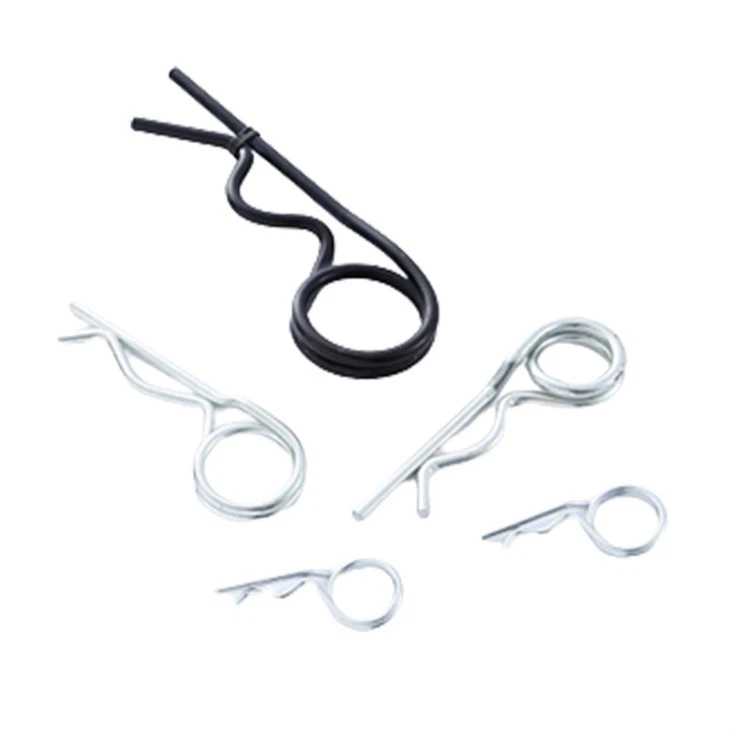
Cotter pins, like the Din11024 R Cotter Pins, are another type of pin with a different design. They are made from a wire bent into a U - shape with a split at one end. Cotter pins are used to prevent nuts from loosening or to secure parts in place. They are inserted through a hole and then the ends are splayed out to keep the pin from coming out.
Installation and Removal
Spring pins offer significant advantages when it comes to installation and removal. The spring action of the pin means that it can be inserted with relative ease, even in holes with a slightly smaller diameter. This is because the pin compresses as it is inserted, creating a tight fit once in place. Installation usually requires only simple hand tools, such as a hammer or a press fit tool, depending on the size and application.
Removing a spring pin is also straightforward. Unlike some other pins, there is no need for special extraction tools in most cases. Since there is no welding or threading involved, the spring pin can simply be pushed out or removed by using a tool to compress the pin further.
On the other hand, dowel pins often require precise machining of the holes to ensure a proper fit. Installation can be difficult as the pin must be tapped carefully into place to avoid damage or misalignment. Removing dowel pins can be challenging, especially if they are stuck due to corrosion or a very tight fit. Special extraction tools may be required, which can be time - consuming and complex to use.
Taper pins can be tricky to install as they need to be inserted into a tapered hole at the right angle and depth. Installation usually involves tapping the pin until it reaches the correct position. Removal of taper pins can also be difficult, as they rely on a wedging action, and if they have been in place for a long time, they may be very firmly stuck.
Cotter pins require bending and splaying of the ends during installation, which can be time - consuming, especially in large - scale applications. Removal involves straightening the splayed ends, which can be difficult if the pin has been in place for a long time and has become deformed.
Holding Force and Stability
Spring pins provide a reliable and consistent holding force. The spring action ensures that the pin maintains contact with the walls of the hole, even under vibration or shock. This is particularly important in applications where parts need to stay securely connected. For example, in automotive engines, spring pins are used to secure various components, such as gears and bearings, where vibrations are common.
The holding force of spring pins can be adjusted by changing the material, size, and design of the pin. For instance, Slotted Tooth Spring Pins have an enhanced design with teeth that provide additional grip and holding power.
In comparison, dowel pins rely on a press - fit or a tight tolerance fit to hold parts together. While they can provide a high level of precision in alignment, their holding force can be affected by factors such as temperature changes and wear. In applications where there is a lot of movement or vibration, dowel pins may loosen over time.
Taper pins provide a good holding force through their wedging action. However, they are more suitable for static applications where the force is applied in a single direction. In dynamic applications, the wedging action may not be sufficient to prevent the pin from coming loose.
Cotter pins are mainly used for securing parts in place to prevent movement in a specific direction. Their holding force is relatively limited compared to spring pins, especially in applications where there are high - intensity vibrations or forces.
Versatility and Applications
Spring pins are incredibly versatile and can be used in a wide range of applications across various industries. They are commonly used in automotive, aerospace, machinery, and electronics. In automotive applications, spring pins are used to connect suspension components, transmission parts, and engine assemblies. In the aerospace industry, they are used for connecting structural components and control systems, where high reliability and resistance to vibration are crucial.
The Iso8750 Or Din7344 Metric Spring Pins are a popular choice for metric - based applications, offering a standardized solution for various engineering needs.
Dowel pins are mainly used for precise alignment of parts in applications where accuracy is of utmost importance, such as in machine tooling and precision instruments. Taper pins are commonly used in applications where parts need to be disassembled and reassembled frequently, such as in agricultural machinery and construction equipment.
Cotter pins are often used in applications where preventing the loosening of nuts or bolts is the primary concern, such as in bicycles, trailers, and some simple mechanical assemblies.
Cost - effectiveness
Spring pins are generally cost - effective compared to some other types of pins. Their relatively simple design and ease of manufacturing result in lower production costs. Additionally, the ease of installation and removal can save time and labor costs during assembly and maintenance.
In contrast, dowel pins may require more precise machining processes, which can increase the cost of production. Taper pins also need specialized manufacturing techniques to create the taper, which can also add to the cost. Cotter pins, while relatively inexpensive to produce, may require more labor - intensive installation methods, which can increase the overall cost in large - scale applications.
Contact for Procurement
As a spring pins supplier, I understand the diverse needs of different industries and applications. Whether you are looking for standard spring pins like the Iso8750 Or Din7344 Metric Spring Pins or specialized options such as Slotted Tooth Spring Pins, I can provide you with high - quality products at competitive prices.
If you have any requirements for spring pins or need more information about their applications and specifications, please feel free to reach out. I am here to assist you in making the right choice for your specific needs and to ensure a smooth procurement process.
References
- "Mechanical Design Handbook", 2nd Edition, by Robert C. Juvinall and Kurt M. Marshek.
- "Machine Design: An Integrated Approach", 5th Edition, by Robert L. Norton.
- Industry standards and specifications for spring pins and other types of pins, such as ISO 8750 and DIN 7344.
